
 Base Services Hub Agency
From AI Tokens to Privacy Coins: What Crypto Twitter Is Actually Telling Us About the Next Onchain Cycle
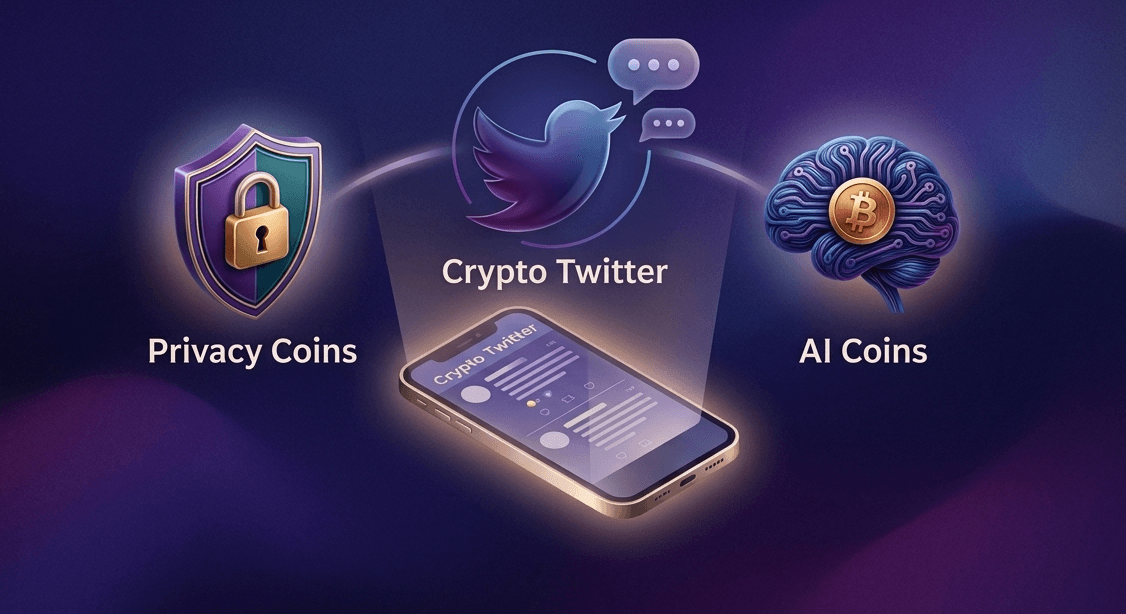
Crypto Twitter narratives are shifting fast. AI tokens and privacy coins are dominating the conversation, and the signal underneath points to a very different onchain cycle than the last one.
TL;DR
- Crypto Twitter narratives are the earliest signal for where capital and builders move next. Right now, AI tokens and privacy coins dominate the conversation.
- AI tokens represent a real shift: onchain compute, verifiable inference, and decentralised model training are attracting serious engineering talent.
- Privacy coins are resurfacing because regulatory pressure is making onchain privacy a necessity, not a niche ideology.
- The next cycle will reward infrastructure that actually works, not hype tokens riding a trending hashtag.
- Builders who pay attention to what CT is signalling (not what it is shilling) will position themselves ahead of the curve.
Every cycle has its narrative. 2017 had ICOs. 2021 had NFTs and DeFi summer. And right now, two themes are louder than everything else on Crypto Twitter: AI tokens and privacy coins.
Most people dismiss CT as noise. And most of it is. But underneath the memes, the ratio'd takes, and the engagement farming, there is a genuine signal about where capital, talent, and builder energy are flowing.
Here is what the current CT conversation is actually telling us about the next onchain cycle.
AI Tokens: Beyond the Hype
Quick Recap: AI tokens are not just riding the ChatGPT wave. A real category of onchain AI infrastructure is emerging, and it is attracting serious builders.
The AI token narrative started as pure reflexivity. OpenAI gets attention, so anything with "AI" in the name pumps. That part of the market still exists, and most of it is noise.
But something more interesting is happening underneath. Projects building onchain compute networks, verifiable inference layers, and decentralised training pipelines are gaining traction. Not because of branding, but because they solve real problems.
Centralised AI has a trust problem. When you call an API, you have no way to verify what model ran, what weights were used, or whether the output was filtered. Onchain AI infrastructure fixes this by making inference verifiable and compute markets transparent.
The projects worth watching are the ones building actual infrastructure:
- Decentralised compute markets that let GPU owners sell capacity without intermediaries
- Verifiable inference protocols that prove a specific model produced a specific output
- Onchain model registries that track training data provenance and model versioning
- AI agent frameworks where autonomous agents transact and settle onchain
The signal from CT is clear. The smart money is not buying AI tokens for the ticker. They are betting on the infrastructure layer that makes AI accountable and permissionless.
Privacy Coins: Not Dead, Just Dormant
Quick Recap: Privacy coins are trending again, but the catalyst is different this time. Regulatory pressure is making onchain privacy an infrastructure requirement, not a political statement.
Privacy coins have been written off more times than most people can count. Delistings from major exchanges. Regulatory crackdowns. The "nothing to hide" crowd drowning out legitimate use cases.
And yet, privacy is trending on CT again. Why?
Because the regulatory environment has changed. Onchain surveillance is now an industry. Chain analysis firms sell data to governments, corporations, and bad actors alike. Every wallet, every transaction, every DeFi interaction is indexed, labelled, and sold.
For builders, this creates a real problem. You cannot build compliant financial products if every user's entire transaction history is public by default. Institutions will not move serious capital onchain without privacy guarantees. And everyday users are starting to understand that "transparent by default" is not a feature when it means your employer can see your DeFi positions.
The privacy coins gaining traction on CT right now fall into a few categories:
- Protocol-level privacy chains that make all transactions private by default
- Privacy layers that sit on top of existing L1s and L2s, adding selective disclosure
- ZK-based solutions that let users prove compliance without revealing underlying data
- Private DeFi protocols that enable confidential swaps, lending, and yield farming
The narrative has shifted from "privacy is for criminals" to "privacy is infrastructure." That is a meaningful change, and CT picked up on it months before mainstream coverage.
What CT Gets Right (and Wrong)
Quick Recap: Crypto Twitter is the fastest signal in the market, but you need to filter aggressively to extract value from it.
CT is right about direction. When a narrative starts trending across builders, researchers, and serious capital allocators (not just influencers), it usually points to where the next wave of development will happen. CT called DeFi summer early. It called the NFT boom early. And it is calling the AI + privacy convergence early.
CT is wrong about timing and magnitude. The market moves slower than the timeline suggests. AI tokens pumping today does not mean the infrastructure is ready. Privacy coins trending does not mean institutions are ready to adopt them. There is usually a 12 to 18 month gap between CT narrative peak and actual product maturity.
CT is also wrong about specifics. The tokens that trend hardest are rarely the ones that win long term. The projects that ship production-grade infrastructure usually do it quietly while CT is busy arguing about which fork will flip which.
Here is how to filter the signal:
- Watch the builders, not the shillers. When engineers start tweeting about technical problems they are solving, pay attention.
- Follow the grants and funding. Ecosystem funds deploying capital into AI and privacy infra tells you where the chains themselves see the future.
- Track GitHub, not CoinGecko. Commit activity and developer growth are better leading indicators than price action.
- Look for convergence. When AI + privacy + DeFi start overlapping in the same projects, that is where the real alpha lives.
The Builder Takeaway
Quick Recap: The next onchain cycle will reward teams building real infrastructure at the intersection of AI, privacy, and DeFi.
If you are building in Web3 right now, here is what the CT signal tells you:
AI infrastructure is a real category. If you are building anything that touches AI, consider how onchain verification, compute markets, or agent frameworks could make your product more trustworthy and composable.
Privacy is becoming table stakes. If your protocol exposes user data by default, you will lose to competitors who offer selective disclosure. Start thinking about privacy at the architecture level, not as a feature bolt-on.
Composability still wins. The projects that will define the next cycle are the ones that let AI agents transact privately on DeFi rails. The intersection is the opportunity.
Ignore the ticker, watch the repo. The best signal for what will matter in 18 months is not what is pumping today. It is what is being built today.
Risks and Trade-offs
Quick Recap: Both AI tokens and privacy coins carry real risks that CT tends to gloss over.
AI tokens face a fundamental question: does this actually need to be onchain? Many AI projects are wrapping centralised APIs in a token and calling it decentralised. If the model runs on a single provider's GPUs and the token is just a payment rail, you have not decentralised anything. You have added friction.
Privacy coins face regulatory risk that is not going away. Governments are actively working to restrict privacy-preserving technology. Projects building in this space need legal frameworks and compliance tooling, not just cryptography. The ones that ignore this will get delisted or banned, regardless of how good the tech is.
Both categories are also at risk of narrative exhaustion. CT moves fast. If these themes do not produce real products within the next 12 to 18 months, the attention will move on and take the capital with it.
The teams that win will be the ones who ship working products while the narrative is still hot, rather than waiting for perfect conditions.
Paying attention to CT is not about trading narratives. It is about understanding where builder energy is flowing and positioning accordingly. Right now, that energy is flowing toward AI infrastructure and onchain privacy. The teams that build at that intersection, with real products and real users, will define the next cycle.
Building onchain AI or privacy infrastructure? Ethereal Labs helps teams design and ship secure blockchain applications. Get in touch.