TL;DR
- In Web3, one bug can erase a company overnight. Track record is everything.
- The right partner is proven, senior, and product-minded. The wrong one ships fast and breaks at scale.
- Cheap and big are not the same as reliable. Founders who chase price tags learn this the hard way.
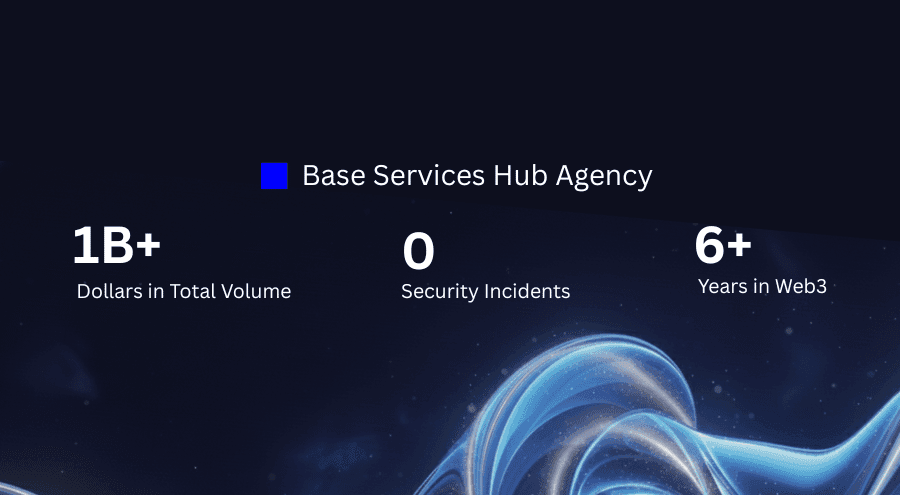
- Ethereal Labs has shipped 15+ projects, processed over $1B in onchain volume, and recorded 0 security incidents.
- This post is what to actually look for when picking a Web3 development partner, based on what we've seen go right and what we've seen go very wrong.
Most Web3 projects do not die from bad ideas. They die from bad execution.
A single contract bug, a single misconfigured access control, a single rushed deployment, and the company is gone. There is no rolling back. There is no "hot-fix in production tomorrow." It is onchain and it is final.
That is why the choice of development partner is not a procurement decision. It is a survival decision.
What we mean by "proven"
Quick Recap: Proven means battle-tested in production at real scale. Not pitch decks. Not promises.
A lot of agencies pitch on the same buzzwords. Senior team. Full-stack. Multi-chain. End-to-end.
The only signal that matters is what their code did under load.
Ask:
- How much onchain volume have their contracts actually processed
- Any exploits or rugs post-launch
- Which products are still live and used right now
- How many of their projects survived a market downturn
We've shipped 15+ projects, handled over $1 billion in cumulative onchain volume, and recorded zero security incidents. Numbers like that are not marketing copy. They are forensic evidence that the engineering held up.
Why "cheap" and "big" both fail
Quick Recap: Cheap agencies cut corners on review and testing. Big agencies hide juniors behind account managers. Both fail at scale.
The common pattern we see when founders come to us after a bad first attempt:
- Cheap agency shipped something that compiles. The contracts had no audit, no fuzzing, no second pair of eyes. It works on testnet. It cracks under real users.
- Big agency promised everything and assigned a project manager. The actual code was written by a junior on rotation. The senior name on the website never touched the codebase.
Both of these are common because both look fine on paper. The price is right. The logo is impressive. The pitch is polished.
The problem only shows up when real users arrive. By then it is too late.
What good actually looks like
Quick Recap: Direct access to senior engineers, deep product thinking, and skin in the outcome. Anything less is a risk multiplier.
A real Web3 engineering partner has four things.
Direct access to the people writing the code. No account managers. No middle layers. When something breaks at 2am, the person fixing it is the same person who designed it.
Senior-only or near-it. Juniors are great, but they should not be learning on your codebase. Web3 is unforgiving. The cost of mistakes is paid in user funds.
Product-minded engineering. A good partner asks "who are your users" and "how will this scale" before they ask "what stack do you want." Code is a means, not the goal.
Skin in the outcome. Track record is the cheapest form of skin. An agency that has zero incidents across $1B+ has every incentive to keep that record. One that has nothing to lose can ship anything.
What we ask before we take a project
Quick Recap: Scoping is the most important part of the engagement. Most disasters start with a vague spec.
Before we write a line of code, we want clear answers to:
- What is the user actually doing on day one
- What does the contract custody, and what happens if it fails
- Which chain, and why that chain
- What is the launch plan, and what can wait until v2
- What is the audit posture, and who pays for it
- What is the post-launch ownership, monitoring, and incident plan
If a founder cannot answer half of these, we work through them together before scoping. If an agency does not ask any of these, that is a red flag. They are about to build whatever they feel like, and you will own the consequences.
Real examples, real pressure
Quick Recap: Sport.Fun and Beezie are public, live, at-scale builds. The systems we shipped were under real pressure on day one.
Sport.Fun (Football Fun) is an onchain fantasy sports prediction platform on Base. We built the smart contracts and a custom Uniswap V2 fork that we modified into an ERC-1155 to ERC-20 DEX. Hundreds of unique assets, each with its own liquidity and pricing, all settling in real time.
The system processed $10M in volume in its first two weeks and is now well past $100M cumulative. It launched in difficult market conditions and held up.
Beezie is an onchain real-world-asset digital claw machine. Currently the #1 consumer app on Base. We've been driving the engineering work that supports it: 7x faster claw interactions, up to 3x faster page loads, redesigned smart contracts for asset redemption, and we are currently leading the AWS migration that supports its growth.
Both are live. Both are public. Both went through code we wrote and reviewed line by line. That is what production-grade looks like.
Trust is the real product
Quick Recap: A development partner is a multi-year relationship, not a one-time vendor.
Most Web3 projects need engineers in the building before launch and after. The smart contracts go live. Then the indexing pipeline needs upgrading. Then a new chain rollout. Then a v2.
The right partner is one you can keep working with for years. The wrong one disappears the day mainnet ships, leaving you to debug a system you did not build.
Founders who have worked with us once tend to come back. They also refer their friends. That referral chain is the cleanest signal of trust we have, and it is what we work to keep.
Risks and tradeoffs to be honest about
Quick Recap: A senior, proven, product-minded team is not free. Not the cheapest. Not the fastest "yes." That is the trade.
We are not the right partner for every project.
We do not take on projects without scoping. If a founder needs a contract live by Friday with no spec, we say no. That work always ends badly.
We are not the cheapest. The trade for that is the zero-incident record. Cheap is a real cost when the cost shows up as a hack.
We do not pretend to be a 50-person agency. We are a lean senior team with a network. That means tight communication and high quality, not infinite parallel bandwidth.
If any of those are deal-breakers, the right answer is to find a different team. The wrong answer is to push us to compromise on the things that protect your users.
How to pick
Quick Recap: Ask for proof, talk to past clients, and trust your read of who you'll actually be working with.
Five questions to ask any candidate Web3 development partner:
- What is your largest production volume to date, and which contracts handled it
- Who exactly will be writing the code, and can I speak to them
- What is your post-launch ownership policy
- Show me a contract you wrote that has been audited, and the audit
- Walk me through a time something went wrong, and what you did
The right partner will answer all five comfortably. The wrong partner will dodge most of them.
If your project has real money flowing through it, real users depending on it, and a real future to protect, picking the right Web3 development partner is the most important decision you will make this year. Worth getting right.
Looking for a Web3 engineering partner that builds for real users and real volume. Ethereal Labs helps teams design and ship secure blockchain applications. Get in touch.