TL;DR
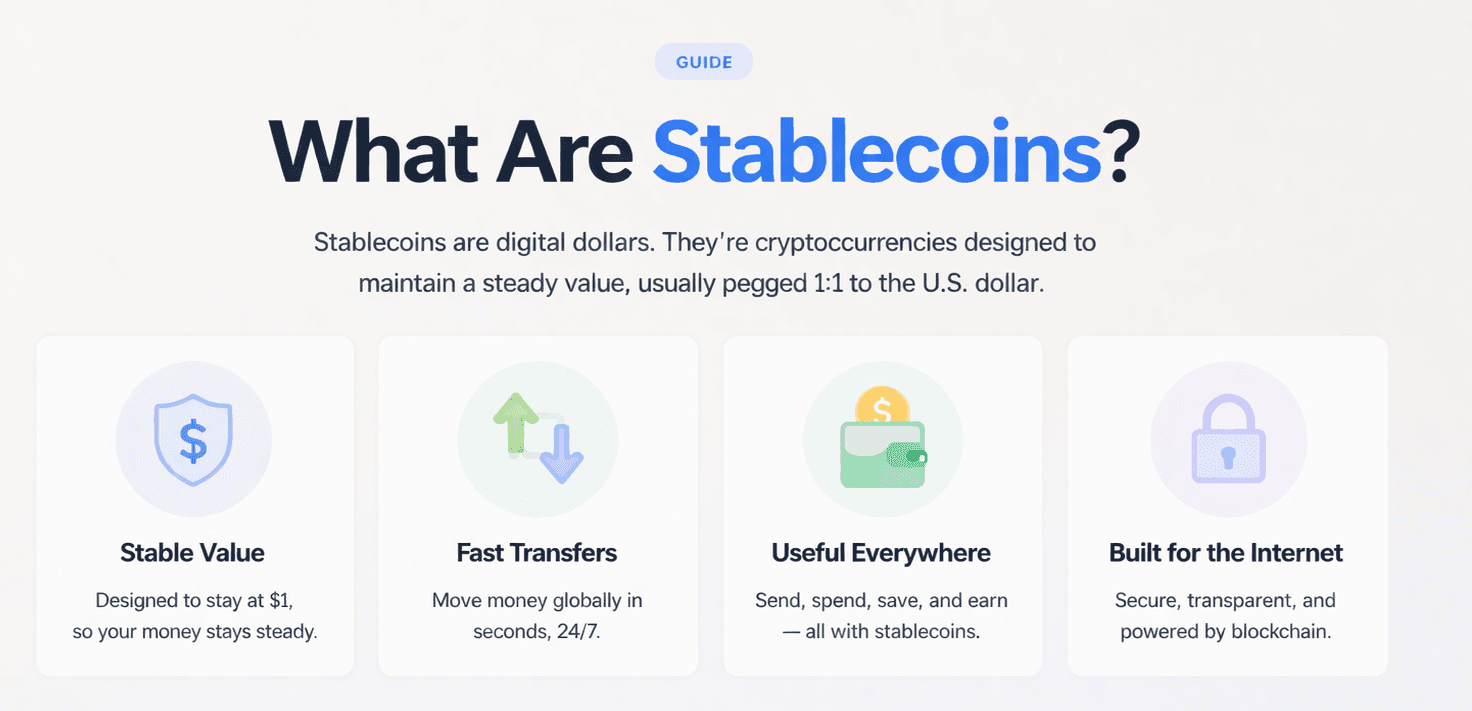
- Stablecoins are digital currencies pegged to real-world assets like the US dollar. They combine the speed of crypto with the stability of traditional money.
- The current financial system is slow, expensive, and excludes billions of people. A simple wire transfer can take days and cost $50+.
- In countries like Argentina, where the peso lost over 50% of its value in a single year, stablecoins give citizens direct access to dollar-denominated savings.
- Stablecoins processed over $10 trillion in onchain volume in 2024. That is not experimental. That is infrastructure.
- You do not need a bank account, a credit score, or government approval to hold stablecoins. Just a phone and an internet connection.
The global financial system is broken. Not in a dramatic, falling-apart way. In a quiet, structural way that costs ordinary people billions every year.
Sending money from London to Lagos takes 3-5 business days. The fees eat 6-9% of the transfer. And if you live in a country where your currency loses half its value every year, your savings evaporate while you sleep.
Stablecoins fix this. Not with hype or speculation, but with straightforward engineering. They are the most practical thing crypto has produced so far.
What Exactly Is a Stablecoin?
Quick Recap: A stablecoin is a digital token pegged 1:1 to a stable asset, usually the US dollar.
A stablecoin is a cryptocurrency designed to hold a fixed value. Most are pegged to the US dollar, meaning 1 stablecoin = $1. Always.
Unlike Bitcoin or Ethereum, stablecoins do not swing 10% in a day. That is the entire point. They strip out the volatility and keep the useful parts of crypto: instant transfers, global access, and programmability.
The biggest stablecoins right now are USDT (Tether) and USDC (Circle). Between them, they hold over $200 billion in market cap. USDC is fully backed by cash and US Treasury bonds, with monthly audits. USDT is larger but has faced more scrutiny over its reserves.
How Do Stablecoins Actually Stay Stable?
Quick Recap: Different stablecoins use different mechanisms, from cash reserves to algorithms, with varying trade-offs.
There are three main types:
-
Fiat-collateralised (USDC, USDT). A company holds real dollars in a bank. For every stablecoin in circulation, there is $1 sitting in reserve. Simple and effective.
-
Crypto-collateralised (DAI). Smart contracts lock up crypto assets worth more than the stablecoins they mint. If ETH drops in value, the system liquidates positions to maintain the peg. It is decentralised but capital-inefficient.
-
Algorithmic (the risky ones). These use code to expand and contract supply based on demand. No real collateral. Terra/UST tried this in 2022 and collapsed, wiping out $40 billion overnight. Most serious builders have moved away from this model.
For everyday users, fiat-collateralised stablecoins like USDC are the safest bet. They are boring by design. That is a feature.
The Current Financial System Is Not Working
Quick Recap: Legacy finance is slow, expensive, and excludes nearly 1.4 billion unbanked adults worldwide.
Here is how the traditional system works when you send money internationally:
Your bank talks to a correspondent bank. That bank talks to another correspondent bank. That bank talks to the recipient's bank. Each one takes a cut. Each one adds a delay. Each one adds a compliance check.
The result: a $200 remittance from the US to the Philippines costs $12-18 in fees. It arrives in 2-5 business days. And both sender and receiver need active bank accounts.
Globally, 1.4 billion adults have no bank account at all. Another 2+ billion are "underbanked," meaning they have limited access to basic financial services. These are not edge cases. This is a huge percentage of the world's population.
The system was built for institutions, not people. Stablecoins flip that.
Argentina: A Real-World Case Study
Quick Recap: Argentina's peso has collapsed repeatedly, and citizens are turning to stablecoins as a survival tool.
Argentina is the clearest example of why stablecoins matter right now.
In 2023, Argentina's annual inflation rate hit 211%. The peso lost more than half its purchasing power in 12 months. Savings in pesos became worthless at an alarming rate. The government imposed capital controls, limiting how many US dollars citizens could buy. Black market exchange rates diverged wildly from official rates.
Argentines responded by adopting stablecoins. Reports show Argentina consistently ranks among the top countries globally for stablecoin adoption relative to population. People use USDT and USDC to preserve savings, pay freelancers, and conduct everyday commerce.
This is not speculation or trading. This is survival. A freelance developer in Buenos Aires who earns in pesos watches their income degrade every single week. If they earn in USDC instead, they hold dollars. No bank required. No government permission needed. No $200 monthly cap on dollar purchases.
The same pattern plays out across emerging markets. Turkey, Nigeria, Venezuela, Lebanon. Anywhere the local currency is unstable, stablecoins become a lifeline.
How Stablecoins Actually Move Money Better
Quick Recap: Stablecoin transfers are faster, cheaper, and more accessible than traditional banking rails.
Let us compare a real remittance scenario:
Traditional wire transfer:
- Cost: $25-50 in fees
- Speed: 2-5 business days
- Requirements: Bank account on both ends, ID verification, correspondent bank relationships
- Availability: Banking hours only
Stablecoin transfer (USDC on Base):
- Cost: Less than $0.01
- Speed: Under 2 seconds
- Requirements: A crypto wallet (free, takes 30 seconds to set up)
- Availability: 24/7/365
That is not a marginal improvement. That is an entirely different category of financial infrastructure.
Businesses benefit too. A company paying contractors across 15 countries can send USDC to all of them in a single batch transaction. No SWIFT codes. No intermediary banks. No waiting until Monday.
The Risks You Should Know About
Quick Recap: Stablecoins carry real risks including regulatory uncertainty, depegging events, and counterparty exposure.
Stablecoins are not risk-free. Here is what to watch:
-
Regulatory risk. Governments are still figuring out how to classify and regulate stablecoins. The US, EU, and UK are all drafting legislation. Rules could change quickly.
-
Counterparty risk. If you hold USDC, you trust Circle to maintain reserves. If Circle fails, your stablecoins could lose value. This is unlikely but not impossible.
-
Depegging events. In March 2023, USDC briefly dropped to $0.87 when Silicon Valley Bank (which held some of Circle's reserves) collapsed. The peg recovered within days, but it showed that even well-backed stablecoins are not immune to banking system shocks.
-
Smart contract risk. Stablecoins on decentralised platforms interact with smart contracts. Bugs in those contracts can lead to losses.
-
Censorship. Fiat-backed stablecoins like USDC and USDT can freeze addresses. They are not censorship-resistant in the way Bitcoin is.
None of these are dealbreakers. But you should understand what you are holding.
Where This Is All Heading
Quick Recap: Stablecoins are becoming regulated financial infrastructure, not just crypto tools.
The numbers tell the story. Stablecoins settled over $10 trillion in onchain volume in 2024. Visa's total payment volume for the same period was roughly $13 trillion. The gap is closing fast.
Major institutions are paying attention. PayPal launched its own stablecoin (PYUSD). Stripe re-entered crypto specifically to support stablecoin payments. Visa and Mastercard are building stablecoin settlement layers.
Regulation is moving towards clarity. The EU's MiCA framework includes specific stablecoin rules. The US is progressing stablecoin legislation through Congress. More regulation means more institutional adoption, which means more liquidity and stability.
The endgame is not "crypto replaces banks." It is simpler than that. Stablecoins become the default rails for moving value across borders. Banks integrate them. Businesses use them. Consumers benefit from faster, cheaper, more accessible payments.
For the 1.4 billion unbanked adults, stablecoins are not an upgrade. They are the first real option.
Final Thoughts
Stablecoins are the first crypto product that solves an obvious, everyday problem. They make money faster, cheaper, and more accessible. For people in stable economies, that is convenient. For people in Argentina, Turkey, or Nigeria, it is transformative.
The technology works. The adoption is real. The regulatory frameworks are forming. This is not about speculation. This is infrastructure.
Building onchain payment systems or stablecoin integrations? Ethereal Labs helps teams design and ship secure blockchain applications. Get in touch.